Defining Observability
In 1960 Rudolf E. Kálmán introduced a characterization he called observability to describe mathematical control systems. In control theory, observability is defined as a measure of how well the internal states of a system can be inferred from knowledge of its external outputs.
Observability is not about data collection — it’s about understanding.
In a world where digital services are delivered through an intricate web of clouds, CDNs, APIs, ISPs, and edge networks, traditional monitoring only shows part of the picture. Observability is the discipline of connecting every signal — from code execution to Internet routing — to understand how systems behave in the wild, from the user’s point of view. It’s how we answer the most important question in digital operations: why something is happening, not just what is happening.
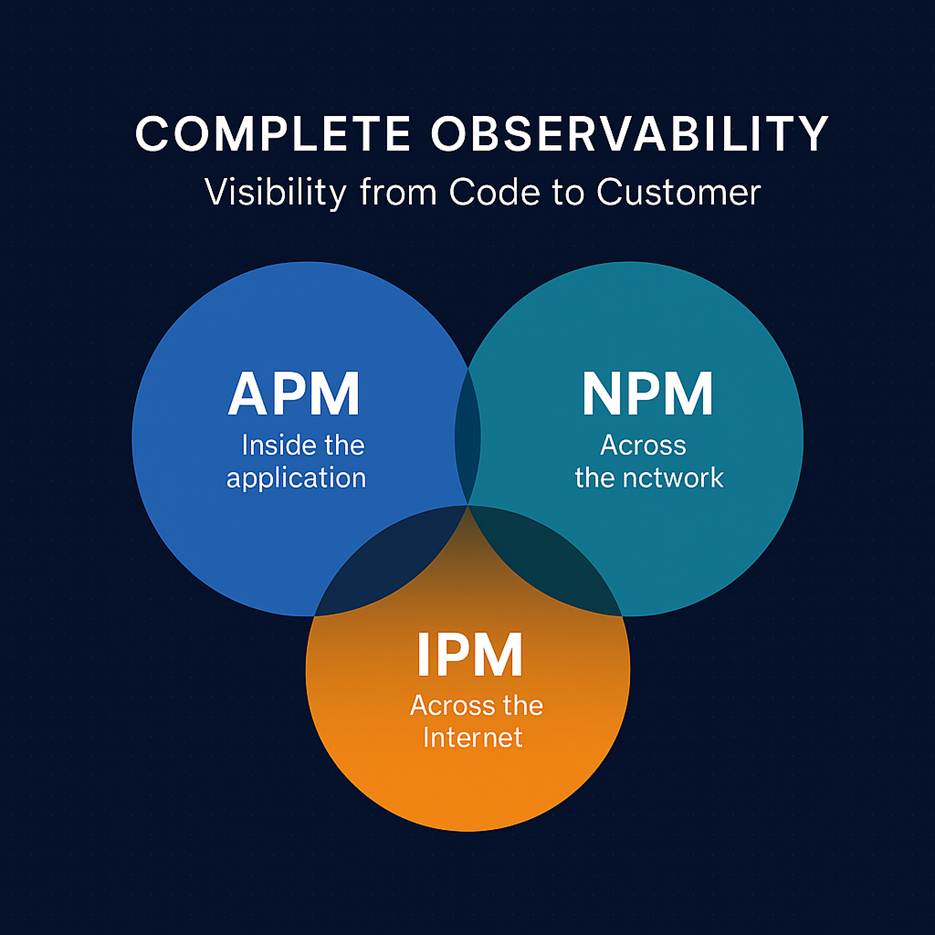
Observability is the ability to see, measure, and understand everything that impacts your user experience — whether it lives inside your infrastructure or across the Internet. It bridges APM, NPM, and IPM into one continuous view, giving teams the insight they need to deliver resilient, high-performing digital experiences.
Observability is a business capability, not just an engineering function
Digital performance is inseparable from business performance. Every millisecond, every third-party dependency, every network hop affects user satisfaction, brand trust, and revenue. Observability empowers teams to protect those outcomes — by detecting issues earlier, resolving them faster, and, ultimately, preventing them altogether.
True observability doesn’t stop at visibility. It drives resilience by design: systems that detect and adapt automatically, organizations that make decisions based on experience-level objectives (XLOs), and cultures that align around user-centric performance. Because in today’s digital ecosystem, you can’t manage what you can’t see — and you can’t improve what you don’t understand.
Observability Principles
- Culture and alignment: observability thrives when teams (Dev, Ops, Product) share user-centric goals and adopt a blameless, continuous-improvement mindset.
- You can’t monitor what you don’t measure: measuring the wrong things (e.g., inside-only metrics) means you’ll miss what matters most
- Focus from the user-outwards: real user experience + real world network conditions rather than only internal metrics.
- Visibility across the full Internet stack (not just data center): CDNs, ISPs, cloud interconnects, SaaS, last mile.
- Intentional KPIs: shift from infrastructure SLAs to Experience Level Objectives (XLOs) that measure what the user actually cares about.
- Contextual data matters: telemetry without context is noise — you need to combine code/infrastructure metrics with network and experience data.
- Resilience by design: observability isn’t just detection — it must enable mitigation, automation and proactive response.
Technologies for Modern Observability
Modern observability requires visibility that spans every layer of digital delivery — from the line of code to the last mile of the Internet. APM, NPM, and IPM together complete that view. APM reveals what’s happening inside your applications — how code executes, where latency accumulates, and why transactions fail. NPM connects that insight to the performance of the networks and interconnections that carry your data, showing how traffic flows and where it degrades. And IPM extends observability beyond your infrastructure, into the global Internet and all the external dependencies your business relies on — DNS, BGP, SaaS providers, APIs, and CDNs. When combined, these disciplines give teams the full picture: not just whether systems are running, but how every layer of the digital supply chain affects user experience in the real world.
Application Performance Monitoring (APM)
Application Performance Monitoring provides deep visibility into how software behaves by instrumenting code, services, and transactions across the application stack. APM solutions trace requests, measure latency, detect errors, and surface performance bottlenecks to help developers and operations teams ensure application health and reliability.
APM as one pillar of a broader observability strategy — essential for understanding how your code performs, but incomplete without visibility into how that performance reaches the user.
Network Performance Monitoring (NPM)
Network Performance Monitoring measures, analyzes, and diagnoses the behavior of networks and the flow of data across them. It provides visibility into packet loss, latency, jitter, routing, and connectivity across internal and external network paths. NPM helps ensure that the digital services relying on those networks are performant, available, and resilient.
Traditional NPM has focused more on devices (health, configuration, and performance for routers, switches, access points, firewalls), while modern NPM considers the global Internet as your network. Modern NPM extends beyond traditional LAN/WAN or SD-WAN visibility to include the public Internet, peering points, remote datacenters and cloud services, ISPs, DNS, CDNs, Edge devices, and third-party services. Because when users experience slowness, the issue is often between your systems — not within them.
Internet Performance Monitoring (IPM)
Internet Performance Monitoring (IPM) is a discipline pioneered by Catchpoint to measure and understand every layer of Internet delivery inside and outside the firewall: from user devices and servers, internal networks and SD-WAN to DNS and BGP routing including SaaS providers, APIs, cloud services, edge devices and the last mile. It allows organizations to see how all dependencies within and outside their control affect their customers and services.
IPM closes the visibility gap left by traditional monitoring and observability tools. It’s the external, user-centric view that connects internal telemetry (from APM and infrastructure monitoring) to real-world Internet conditions. IPM is not optional — it’s the missing link for achieving true observability, digital resilience, and experience-level accountability in an Internet-scale world.